


Who was Tom Stoppard?
The Real Thing, on stage at Katonah Classic Stage from October 22 – November 1, 2026, is both classic Tom Stoppard and a departure. It’s witty; its structure is complex; its preoccupations are intellectual pursuits. But among his vast and varied canon, it also wears its heart most obviously on its sleeve. It is a glimpse inside the heart of one of the English language’s most famous, most beloved, and most celebrated playwrights.
In his early career, Stoppard worked as a reporter and a theater critic before turning to writing plays for both the stage and the radio. In the 18 years between his first play and 1982’s The Real Thing, he wrote six pieces for the radio and 20 for the stage, including Rosencrantz and Guildenstern Are Dead, his breakout hit. After The Real Thing, he wrote more than 16 original plays and adaptations for the stage as well as writing and polishing screenplays, known as “script doctoring.”
His work alluded to, commented on or borrowed from classic works of literature and philosophy, from the Greeks and Romans to Samuel Beckett and Vaclav Havel. He often drew on consequential historical events and real-life figures of intellectual power and influence. For much of his career, the sparkling braininess on display in Mr. Stoppard’s works led some critics and audiences to conclude that his plays were chilly, heavy on the head, light on the heart. But that began to change with The Real Thing and by 1997 he had addressed head on the role of love in a life.
Another criticism he weathered was that his work was politically aloof, a charge he more or less acknowledged as accurate. “Some writers write because they burn with a cause which they further by writing about it,” Mr. Stoppard wrote in The Sunday Times of London in 1968. “I burn with no causes. I cannot say that I write with any social objective. One writes because one loves writing, really.”
He amplified the point in a 1977 interview with Time Out London, getting close to defining his art as the pure exercise of emotion-free knowledge and the audacity to make things up. “I used to feel out on a limb, because when I started to write,” he said, “it was considered worse than outré if you weren’t writing about Vietnam or housing. Now I have no compunction about that.” He added: “‘The Importance of Being Earnest’ is important, but it says nothing about anything.”

Daniel Radcliff and Joshua McGuire Rosencrantz and Guildenstern are Dead at The Old Vic
For someone who writes with such complexity and rigor, Stoppard is astonishingly prolific. From radio plays in the 1950s; to the smashing success of Rosencrantz and Guildenstern Are Dead in 1966; to the nine-hour, three-part epic The Coast of Utopia in 2002; to his deeply personal masterpiece Leopoldstadt, which premiered when he was 82 years old, Stoppard has been unstoppable. He is a fixture of the English-language theater scene, with 37 full-length plays and theatrical adaptations, and is one of the most-produced dramatists on the English-language stage worldwide. In 2008, The Telegraph named him the 11th most powerful person in British culture.
His eminence has been well-rewarded as well. He is the winner of five Tony Awards for best play, spanning his entire career: both his first major play (Rosencrantz and Guildenstern…, 1968) and his last (Leopoldstadt, 2023) won the award, alongside Travesties (1976), The Real Thing (1984), and The Coast of Utopia (2007). He’s won three of the West End’s Olivier Awards, for Arcadia (1994), Heroes (2006), and Leopoldstadt (2020), and he has been nominated for several BAFTAs. A playwright who embraced his adopted homeland with relish, he was made a Knight of the Order of the British Empire in 1997, one of three awards he received from Queen Elizabeth II.
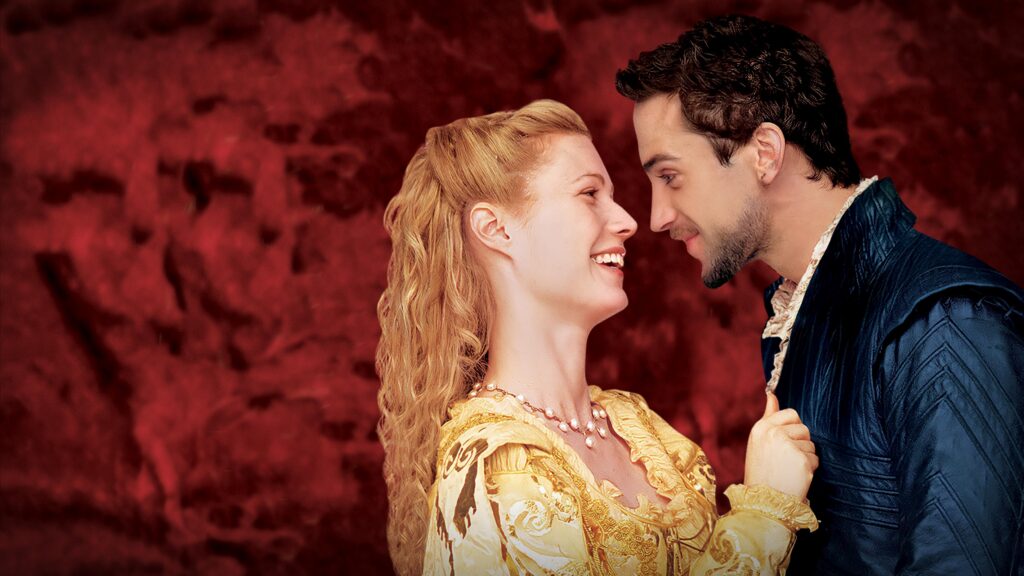
Gwyneth Paltrow and Joseph Fiennes in Shakespeare in Love
The 1980s brought on the rise of Stoppard’s screenwriting career as well, with his co-writing alongside Terry Gilliam and Charles McKeown to create Brazil, a satirical science fiction comedy, which received nearly universal positive reviews. From this, he quickly rose in acclaim, earning the opportunity to write the script for two Steven Spielberg films: Empire of the Sun, and Indiana Jones and the Last Crusade, the third installment of the beloved adventure series starring Harrison Ford. He won an Oscar for cowriting Shakespeare in Love.
“Obviously, the plays are more unlike each other than like each other, but people who take pleasure in finding connections will have no trouble finding them,” Stoppard told The New Yorker. Stoppard’s work is never about one thing. His plays have been compared to prisms, Russian nesting dolls, and kaleidoscopes, continuously refracting — or revealing — their themes. The Real Thing is about love, performance, and writing. Hapgood deals with espionage and quantum physics. The Hard Problem explores neuroscience and hedge funds. And Arcadia delves into chaos theory, Romanticism, thermodynamics, Lord Byron, and English gardens.
Stoppard’s influence on his peers is most evident in his ubiquitousness: no one writes quite like him, so the search for a “Stoppardian” play often leads right back to the master.
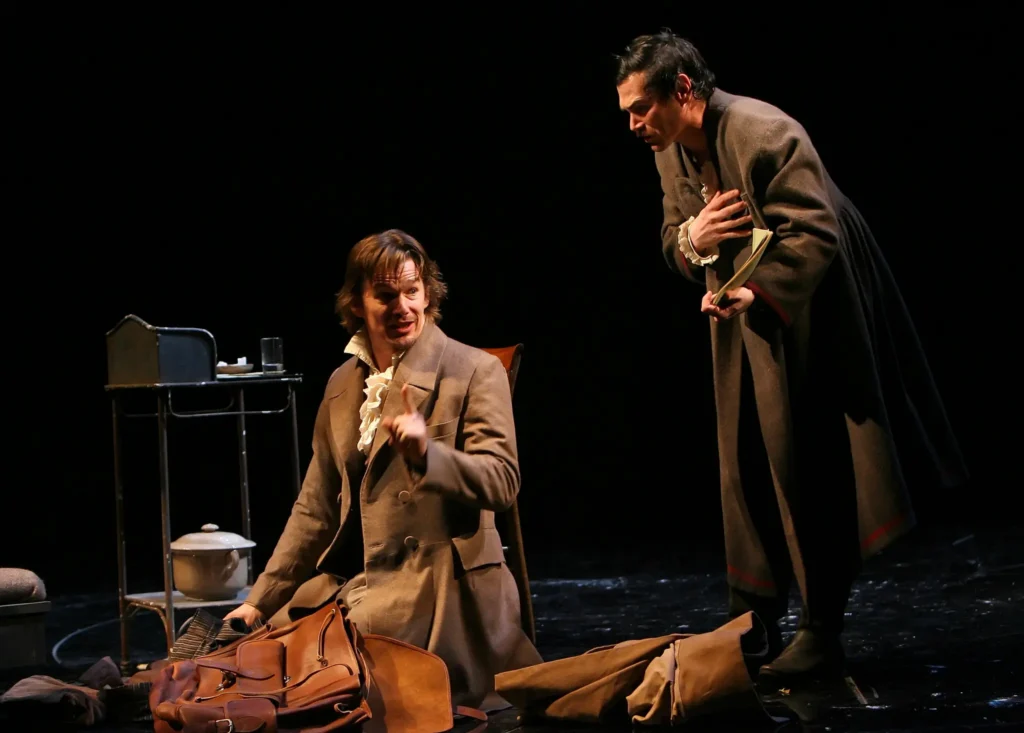
Ethan Hawke, left, as Michael Bakunin and Billy Crudup as Vissarion Belinsky in “Voyage,” part one of Stoppard’s three-part The Coast of Utopia.Credit…Sara Krulwich/The New York Times
But his playfulness with structure—without sacrificing plot or complex argument—has influenced many writers. And while he was not the first person to rework Shakespeare to his own ends, he is among the most successful; Rosencrantz and Guildenstern Are Dead is often cited as direct inspiration for writers who tell an old tale in a new way.
For all his influence, though, Stoppard is just as willing to be influenced by the canon he has such a major place in. As he did with Hamlet in Rosencrantz and Guildenstern Are Dead, The Real Thing makes hay of some of his forbears, playfully invoking earlier masterpieces to place them in conversation with his own work. A trio of references to classic (and bloody) romantic tragedies about impossible, improbable, or imprudent love underpins his urbane dramedy.
Most prominent of the plays-within-this-play is ’Tis Pity She’s a Whore, the 1629–1633 Jacobean tragedy written by John Ford about the disastrous affair between a pair of siblings. In The Real Thing, Annie also stars in Miss Julie (produced by Katonah Classic Stage in 2025), August Strindberg’s 1888 naturalistic play set on an estate in Sweden about the irresistible and tragic attraction of Jean, a manservant, and Miss Julie, his aristocratic boss’s daughter. Finally, Othello, Shakespeare’s classic tragedy about jealousy, mistrust, and what happens when infidelity is assumed rather than confirmed, is invoked via a blood-spotted handkerchief.
In addition to Shakespeare, Strindberg, Coward (whose Private Lives was produced by Katonah Classic Stage in 2022)and Ford, Stoppard has been influenced by artists as varied as Polish and Czech absurdists, Oscar Wilde, and TS Eliot. He integrates his influences with his own genius to expand our notion of what theater can be and discuss.
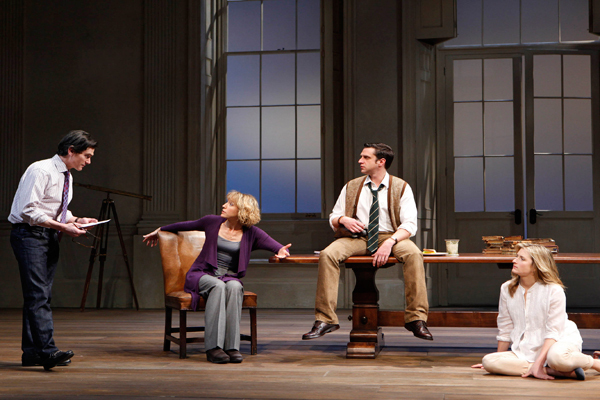
Billy Crudup, Lea Williams, Raul Esparza and Grace Gummer in the 2011 Broadway production of Arcadia (Photo Credit: Carol Rosegg)
He can turn physics into a thriller, math into romance, and a minor historical footnote into a meditation on time and memory. Stoppard’s real legacy might be in that boundless imagination: he shows us that if a topic is fascinating to a writer, no matter how esoteric, it can be fascinating to an audience too when coupled with the right structure, wit, and enthusiasm.
Sir Tom Stoppard died peacefully at his home in Dorset, England, on November 29, 2025. His last play, the Tony-winning Leopoldstadt, was inspired by his own family history about a Jewish family in Vienna confronting the rise of the Nazis. “Leopoldstadt was a big thing to get past. I thought it was a nice big solid work to finish on but what else am I supposed to do? I’m a playwright, by more than, as it were, labeling. I feel like somebody who writes plays while they’re still alive.” How lucky we are that he did.
“I worked with Tom Stoppard for almost a year while we rehearsed and performed his play The Coast of Utopia. It was the single greatest learning experience of my life. It was as if he took us to the top of Mount Olympus and showed us the view. I believe he spent his life up there. I only spent but a few moments, but I will forever know what “magnificent” looks like.” – Ethan Hawke
Read more tributes to Tom Stoppard here: https://www.nytimes.com/2025/11/30/theater/tom-stoppard-tributes-reactions.html?searchResultPosition=7
Link to Charlie Rose Interview:
https://youtu.be/ZoBa6QXUihQ
THE REAL THING
OCTOBER 22nd through NOVEMBER 1st
at
Whippoorwill Hall
North Castle Library
Kent Place
Armonk 10504

ArtsWestchester

Westchester County Legislature

The Arnow Family Fund
Special Thanks to